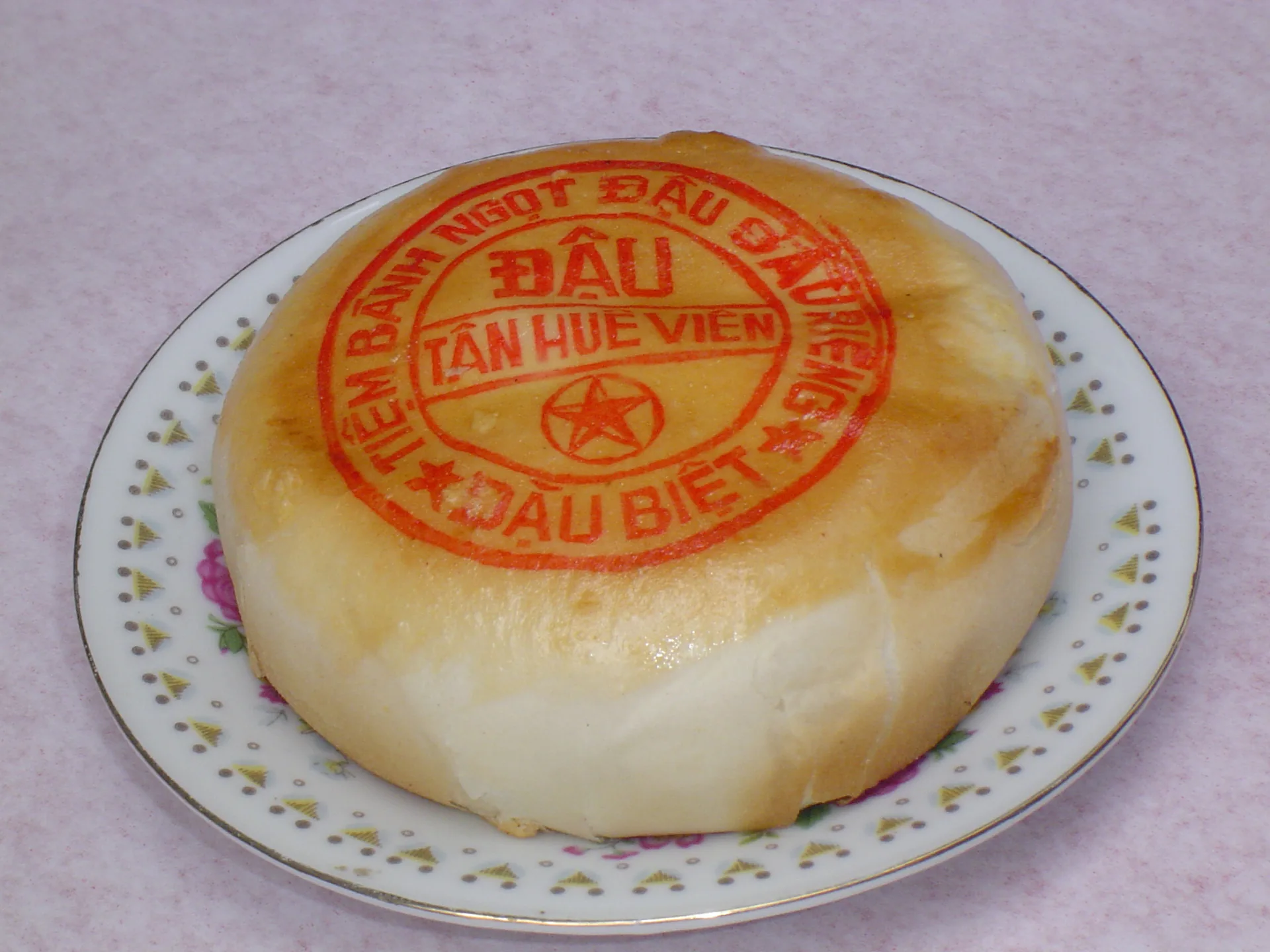
Banh Pia
What Is Banh Pia?
Banh pia is a small, round pastry from the Mekong Delta city of Soc Trang, built from dozens of paper-thin layers of dough wrapped around a sweet filling of mung bean paste, often combined with durian and sometimes a salted egg yolk at the center. Baked until the outer layers turn a light golden color and become delicately flaky, it offers a distinctive combination of textures in every bite: crisp, shattering pastry giving way to a dense, fragrant, sweet filling.
The durian version is by far the most famous and sought-after, prized for the way the fruit's intensely rich, custardy flavor infuses the mung bean paste, though milder versions without durian are also widely available for those who prefer to skip the fruit's famously polarizing aroma. Sold in boxes of individually wrapped pastries, banh pia has become one of the most popular sweet souvenirs travelers bring home from a trip through the Mekong Delta.
Origin and Cultural Significance
Banh pia's origins trace to the Chinese-Vietnamese community of Soc Trang province, particularly the Teochew Chinese diaspora who settled in the Mekong Delta generations ago and brought with them a tradition of layered, flaky pastry-making. Over time, the recipe was adapted with distinctly local ingredients, most notably the addition of durian, a fruit grown abundantly in the surrounding Mekong Delta orchards, giving the dish its now-signature Vietnamese identity distinct from its Chinese pastry ancestors.
Soc Trang has since become almost synonymous with banh pia production, home to numerous bakeries, some family-run for multiple generations, that have turned the pastry into a major local industry and a source of regional pride. The dish is deeply tied to Mid-Autumn Festival celebrations and other holidays, when families exchange boxes of banh pia much the way mooncakes are given elsewhere, though it's also eaten and sold as an everyday treat and travel souvenir throughout the year.
What It Tastes Like
The pastry itself is the technical showcase of banh pia: dozens of impossibly thin layers of dough, achieved through a laborious rolling and folding process, that bake up light, flaky, and faintly crisp, shattering pleasantly with each bite rather than being chewy or dense. It carries a subtle butteriness and a light sweetness of its own, though it plays a supporting role to the filling at the pastry's center.
The mung bean and durian filling delivers rich, dense sweetness with the fruit's distinctive custardy, faintly sulfurous aroma coming through clearly, an intensity that durian lovers find irresistible and newcomers may need a moment to adjust to. Versions that include a salted egg yolk at the center add a savory, slightly mineral counterpoint that cuts through the sweetness, creating a more complex, rounded flavor overall.
Where to Find the Best Version
Soc Trang is the undisputed home of banh pia, and the city and surrounding province are dotted with bakeries specializing specifically in the pastry, many of which have built reputations over decades and are considered local institutions. Look for bakeries that sell banh pia freshly made rather than mass-produced boxes that may have sat in storage, since the pastry's flaky texture is noticeably better when eaten within a reasonable window of baking.
The pastry is also widely available in supermarkets and gift shops across Vietnam, particularly around Mid-Autumn Festival, though these mass-market versions vary considerably in quality compared to a fresh box bought directly in Soc Trang. Travelers passing through the Mekong Delta are well advised to seek out a well-regarded local bakery rather than settling for a boxed version bought elsewhere.
How to Eat It
Banh pia is sold individually wrapped, typically in a light plastic film that keeps the delicate pastry layers intact, and is eaten simply by unwrapping and biting directly into the pastry, no utensils or preparation needed. It's traditionally paired with a cup of hot Chinese or Vietnamese tea, whose bitterness helps balance the pastry's rich sweetness.
Because of its sweetness and density, banh pia is usually eaten in small quantities, one pastry making a satisfying dessert or afternoon snack rather than something consumed multiple pieces at once. It keeps reasonably well for days without refrigeration, which is part of why it travels so well as a souvenir gift.
A Dish Worth Seeking Out
Banh pia represents one of Vietnam's most technically impressive pastry traditions, a product of Chinese-Vietnamese culinary heritage adapted with distinctly local Mekong Delta ingredients. For travelers passing through Soc Trang or the wider Mekong Delta, seeking out a fresh box from a reputable local bakery, durian filling included for the adventurous, is a delicious way to taste a genuinely regional specialty and bring a piece of it home.
Information notice: Prices, opening hours, and travel conditions can change. Content on EnViet is reviewed periodically but may not reflect the most current situation. Please verify important details with official or local sources before travelling or booking. Costs are estimates and may vary by season, exchange rate, and travel style.
EnViet Editorial Team
The EnViet Editorial Team creates practical Vietnam travel and food guides using local knowledge, public sources, and manual editorial review. Content is reviewed before publication and updated periodically.